“I felt like a hair standing up on the arm of the world.” (Maria Gray on Vesper)
Maria Gray is a contributor to Half Mystic Journal Opus II, Issue III: Vesper. Her work appears in Best New Poets and ONLY POEMS, among others. Her debut chapbook, Science Before Fiction, is forthcoming from Game Over Books in fall 2026. She is a Sainsbury Fellow at Hunter College in New York City, where she is pursuing her MFA in creative writing. She calls on you to recommit yourself to the liberation of the Palestinian people each day.
We asked three Opus II, Issue III contributors for their personal definitions of vesper: how it’s formed, where it’s been, what it could be. Here is Maria Gray’s vision of an event horizon, a bell tolling in a vacuum, a cicada’s song harsh and generous enough to wear twilight to bone…
While considering the term vesper in relation to my work, I keep returning to John Keats’ theory of negative capability—in essence, the capacity to bear the unknown “without any irritable reaching after fact or reason.” A poem is a closed world with its own systems of logic and gravity; the greatest poems surprise the poet as much as the reader. In order to truly let surprise in, you have to allow the poem to arrive on its own timeline and terms. To facilitate this, you must let go of what you know to be true.
Vesper is an invitation into the unknown. It derives from Latin, meaning “evening star”; it can refer to a call to prayer or song. There are also etymological threads of westwardness, or “the direction in which the sun sets.” This quite literally brings me to the horizon (apologies to the band)—there is no vesper without horizon. Both are as constant as they are temporal. They have a quality I can only describe as “verging.”
I’ve been mining old notebooks throughout my chapbook revision process and recently revisited notes from a workshop I took with Ocean Vuong a few years ago. In one of his lectures, he spoke of poetic work as approaching the horizon, an act of pursuit. “If we’re lucky,” he said, “we’ll never reach it.” The work is the act of reaching, but it is no arrival.
“Partial Eclipse” in Half Mystic Journal Opus II, Issue III: Vesper is the final poem in my chapbook Science Before Fiction, forthcoming this fall from Game Over Books. Much of the book concerns a prolonged period of sudden, debilitating neuroimmune illness; I’ve been thinking about survivorship, personal and collective catastrophe, and the act of living in an aftermath. There is vesper in how chronic illness warps your sense of self and future. In Illness as Metaphor, Susan Sontag refers to illness as “the night-side of life.” To live in a state of horizontality is, too, an act of verging. I felt I had one foot in the densest darkness, the other in the “real world” (which had never seemed faker). Vesper is the real world estranged from itself.
For me, those years were a crash course in negative capability. How can you be sure of anything if you don’t know how far your legs will take you on a given day? If you’re unsure when or if it will ever end? If the one person you knew would tell you the truth wasn’t there anymore? On my worst days, I drew my curtains, turned off the lights, and laid flat in the dark. Light was unbearable. I went missing from my own life. The fragmented nature of “Partial Eclipse” has always been its center of gravity; I am not interested in narrating “what happened” as much as conveying the sense of totality of the speaker’s losses, how alien and painfully temporary it feels to return to the world after such a period.
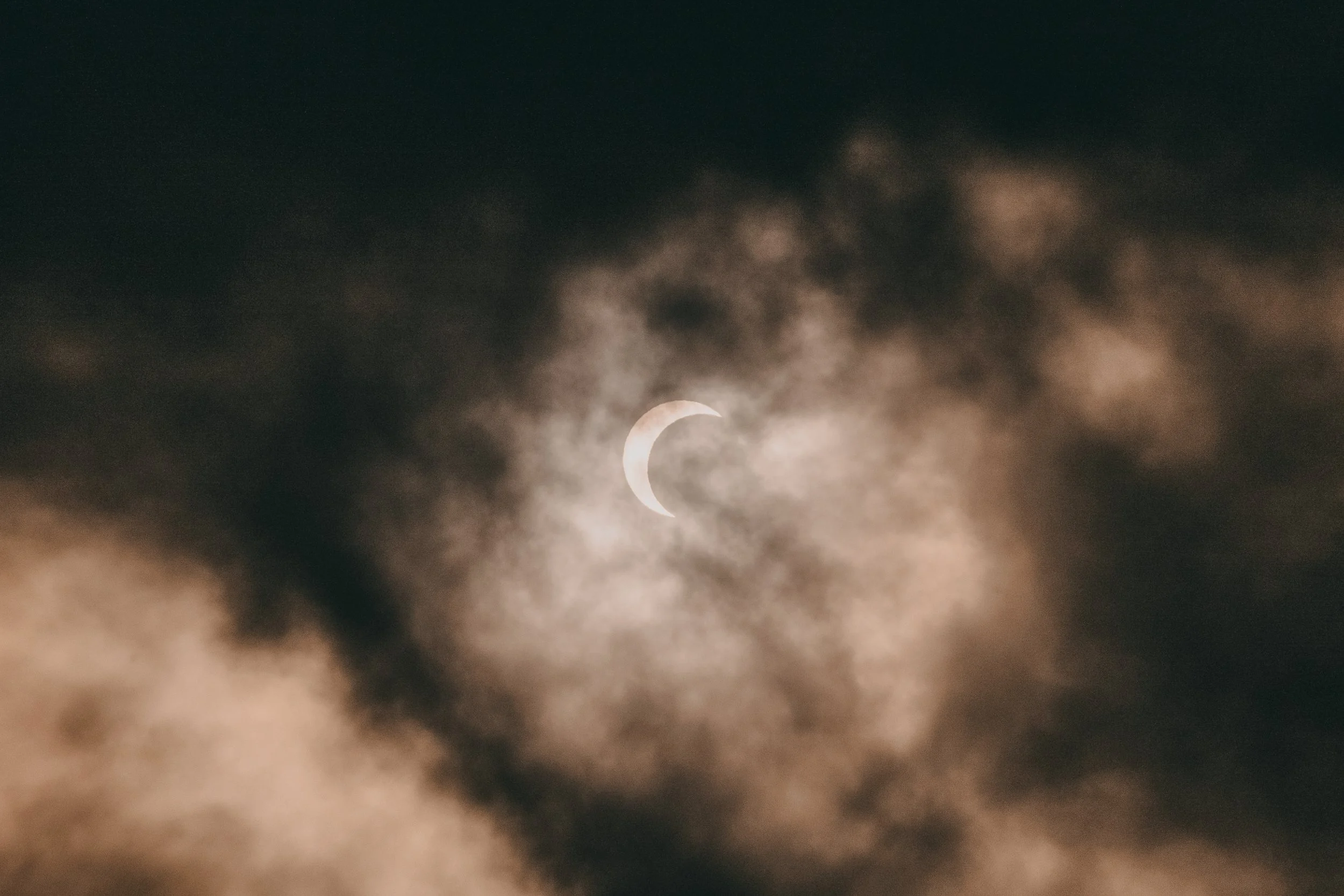
I have seen a partial eclipse, as narrated in the poem, but I have also seen a total eclipse. I won’t pretend to know the first thing about logarithms, but even when 99% of the sun is covered, that 1% of sunlight is so strong, it’s nothing close to a total eclipse. Annie Dillard said it all: there is something otherworldly about daytime unhinging itself from the necessity of light. Like poetry, an eclipse estranges familiar images. During totality, I felt like a hair standing up on the arm of the world.
Mystery with and without invitation are two distinct things. The gift of vesper is the invitation into mystery. Vesper is the state in which strangeness and attention are both heightened, allowing us access to beauty that would otherwise go unconsidered.
Maria Gray’s “Partial Eclipse” is featured alongside twenty other pieces in Half Mystic Journal Opus II, Issue III: Vesper, a constellation of contemporary art, lyrics, poetry, and prose dedicated to the celebration of music in all its forms. The vesper issue does not arrive so much as descend: unhurried as smog or sleep paralysis, inevitable as the ouroboros’ endless coil. A shattered mirror multiplies the face of darkness, silence textured and breathing, the body made uncertain of its edges. You’ve been here before, in the dream that returns you always to the same locked room. The door opens only inward. You’ve been knocking all night. Come inside.