
“I trust poetry more than my own ego.” (An Interview With CJ Scruton)
CJ Scruton’s work is as melodic as it is visceral. Her debut poetry collection, Suite for Hallucinated Voices—out last month with Half Mystic—is a piercing exploration of the inextricable violence and tenderness of desire. The book renders the love poem prayer, elegy, and symphony at once, as Scruton demands the reader consider how performance shapes how we feel, what we speak into existence, the messages we’re willing to receive in our quest for understanding: “Listen, / I am rehearsing / for a life where I am still in love.”
We spoke with CJ about surrendering to your art, the compelling messiness of confession, and how to truly listen to the heart of another. Please welcome her to the Half Mystic blog!
H/M: Suite for Hallucinated Voices is, in your own words, “an ode to the violent surrender of vulnerability,” which is an incisive description of how it feels to fall in big, sweeping love for the first time. How do you experience surrender while writing?
CS: I had such difficulty with every word when I had to describe the book! On some level, it all feels so corny when I try to spell it out plainly... but then, maybe that’s the first surrender? Admitting vulnerability is corny, but we should do it anyway?
Surrendering while writing is the easy part for me: the words, materials, technique will show me where a piece needs to move. The writing will usually tell me what I’m feeling or avoiding before I realize it consciously. Surrendering to that process is easy because I trust poetry more than my own ego.
It’s performing that I have to work at. Sharing work still has a 50/50 chance of feeling great and making me want to bash my head against a wall—even when it’s well-received. That’s my litmus test to know I’m making work that matters to me, so I suppose surrender—working through the tougher reaction—is just part of performing. I’ve come to accept it as an inevitable element of my process, and find healthier ways to work with those impulses rather than pretending I don’t hear them.
The book’s structure is based on that of an orchestral performance, and it includes musical scores intended to be played alongside the written words. In “Grave,” you write: “In my mind if the notes are pretty any story can sound sweet.” While working on these pieces, did the music or the words come to you first, or did they arrive together?
By the tail end of the initial COVID lockdowns, I hadn’t read poems live in two or three years. As I started to get back to it, performance became central to my practice after years away from music. Thinking about the multiple ways I could perform a poem shifted how I wrote even pieces meant mainly for the page. The music came first in Suite for Hallucinated Voices, but the performance and poetry texts quickly shaped themselves around each other, like climbing vines placed in the same pot. While the language often takes center stage in individual pieces, the book’s structure follows the sequence I’d want audiences to hear, the highs and lows as they’d play out in the music.
With the exception of “Sweet,” the first poem in the book, every piece begins with the word “listen”—functioning at times as a command, at others a gentle instruction, and at still others a plea to be understood. Could you elaborate on the choice to begin over and over with this direct address?
As I see it, confessions themselves are mostly uninteresting. Watching someone in the act of confession, with all its messy emotional politics, is a little more intriguing. Watching somebody who’s begging to be heard and afraid they won’t be, or someone who’s insisting, No really, listen, you have to listen to me here, it can’t wait—right away, those tensions are much more compelling to me.
Suite for Hallucinated Voices is a book fundamentally about confession, about the terror of revealing what feels real inside your head, to risk learning that it doesn’t match others’ perceptions. But it’s also a book that finds no other way to confront those disjunctures than by speaking them aloud. The anaphora developed as one way the poems could call attention not just to their images, but also to their own shaky gestures of negotiating reality and voice. It’s not a book about what we hear so much as it’s about how we listen.
I’m interested in this distinction between the “uninteresting” nature of a confession’s content and the perhaps more compelling act of confessing. If I’m following, the difference lies in the presence of a witness—in this case, the reader of the poem. It’s a role that holds great significance in marriage, where a witness must be present to validate the legal bond, and in the Bible, where witnesses to acts of God are both receivers of those events and messengers who recount the events to others. How were you considering your readers as witnesses during the writing process?
I think that point about “witness” and “witnessing” is apt. I love the confessional mode, which maybe gives me an impulse to interrogate why I feel so touched, so reached by some instances of confessional art, and so distant from and disinterested in others. You’re expressing exactly how I feel, a lot of the time—that the most compelling confessional work asks confessor and witness to share a mutual connection, or further tasks the witness with doing something. Tasks us with complicity, even. Topaz [Winters, Half Mystic’s editor-in-chief] once wrote to me that Suite for Hallucinated Voices felt like a “weighty responsibility,” not just a story to be summarized but an occasion the reader is asked to rise to. I hope that’s how others feel reading it, too.
Each poem is accompanied by performance instructions. These are my favorite little gems of the book, often reading like poems in their own right: the reader is asked to recite “Fugue” “as if confessing your love but pursued by the feeling you’ve failed to get the words quite right,” and “With Devotion” “awestruck, as if nervous about building false idols.” Did the writing process for these instructions differ from the bodies of the poems?
Culling the performance instructions was absolutely excruciating, so I’m very happy to hear that it paid off for one reader! I wanted them to act as genuine rewards, details even non-musicians would gain something from reading. They also needed to be performable, not too verbose, and able to communicate expression and emotion as well as vocal techniques. It was a tough task. In some cases, the performance instructions changed more from first to final draft than the bodies of the poems.
I’m curious about what it’s like to read such musical pieces live. How closely do you integrate your own written instructions into the performance of this work?
I perform the work differently in different settings, and I’ll leave a little bit of mystery as to what exactly that looks like. But I’m rarely performing the full suite all at once—that takes about an hour, following the score. I’m getting a chance to perform it at the University of Wisconsin-Milwaukee this month, which I’m excited about! More often, though, I blend and remix a few pieces’ musical instructions to create set lists that feel cohesive in abridged performances. It’s an open, improvisatory score, and since I wrote it to be forgiving to performers who wanted to make it their own, that allows flexibility for me, as well. I’m always making some effort to play with the audience’s attention to and relationship with sound.
Suite for Hallucinated Voices came together over the course of a decade, during which time you began and ended a romantic relationship with, as you put it, “the first great love of [your] life.” How does this relationship haunt the book?
It’s a benevolent haunting, I’d say. That love deeply changed me in ways that appear in the book, but Suite for Hallucinated Voices isn’t really “about” any single relationship. It starts with a speaker who is very willing to lose herself in love: a wasp crawling into a fig and dying is one of the earliest images of the Prelude. For me, the arc isn’t about where that love goes, or even where a relationship goes, but rather: where does she go? Does she indeed lose herself, and does she find her way back? What is she avoiding? What does it look like when the voices she’s running from inevitably catch up to her?
Let’s talk about those voices. You described earlier the speaker “negotiating reality and voice” over the course of the book as auditory hallucinations swirl around her. How did you approach the project of writing a speaker who can’t trust her own perceptions, and how did you work to balance the real, surreal, and unreal in these pieces?
The project stemmed at first from how I interact with reality on a daily basis more than any active craft decision. But on a technical level, I return to dream diction. The assertions and images in a dream never feel weird or surreal, right? They feel completely certain. Suite for Hallucinated Voices follows a speaker who’s confused about her feelings, but the surreal images floating around those feelings are utterly clear. Hallucinations are the most—maybe the only?—certain thing in her uncertain world. I wanted to give the reader no choice but to follow her to that place, that feeling.
Beyond writing, you’ve also displayed sound installations at several galleries and museums, working with sound as a tangible material. How does the process of creating these embodied experiences compare with trying to conjure a sonic landscape solely through words?
All writing, even just words on the page, is time-based media. A printed book is like a score: it tells the reader what to say and when, but it sounds different interpreted by each person who reads it. That’s how music existed for millennia, but audio recording technology means we’re now inundated by music-as-background all the time, and by music that isn’t changed or reinterpreted when it’s replayed. My installations build on modern listeners’ relationships to sound, so I’m trying to use the politics of passive and active listening to achieve certain effects. I generally blend recorded sounds that are sparse and not immediately recognizable, revealing so little that the almost-dead air forces listeners to pay closer attention, even though the loops repeat the same every time.
Which is how I feel about poems, too: you can read them quickly, but the form begs you to slow down and listen actively enough to unearth the layers of the poem’s offerings. Various modalities can make a work feel more passive or require more active participation, but I’m always trying to invite audiences into an investigative feeling: there’s vital information in here somewhere, and we have to hunt to find it. There often isn’t a singular secret or big reveal in my work, but buying into the active experience opens the door for the smaller revelations and interactions that I try to cultivate in both language and sound.
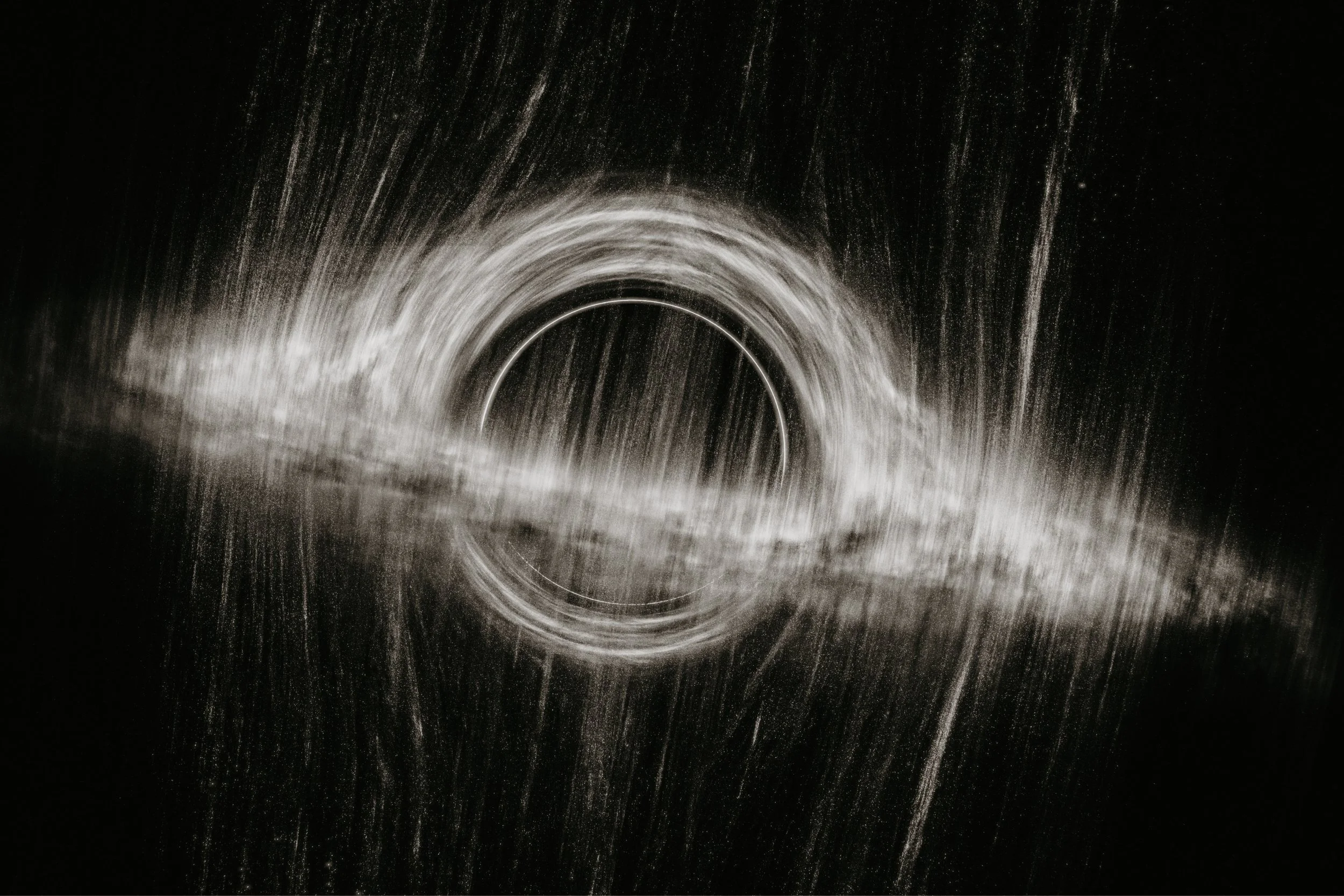
Suite for Hallucinated Voices is suffused with references to outer space: the lover’s face is “a sister galaxy, a primordial collision of stars,” their eyes “an event horizon”; the book closes with a desire for “an alien abduction in a dream.” When you listen for the sounds of space, what do you hear?
I hear huge, terrible, beautiful, edgeless swellings of sound, how I imagine the biblically accurate voices of angels. I was very drawn to prophets’ and angels’ diction when writing Suite for Hallucinated Voices—like dreams, how divinely self-assured they sound, while also being frequently impenetrably cryptic. It’s a delicious and difficult contradiction that I love chewing on. I suppose Suite for Hallucinated Voices mixes the sounds of biblical cosmology with astronomy. Both can leave you with a horrifying sense of smallness and unimportance—like there are answers to humanity’s biggest questions, and you’re not going to like them, so be careful what knowledge you wish for.
But I find my smallness within the universe incredibly comforting. I love being surrounded by big, scary walls of sound, both those that sound pretty and those that never resolve. It feels honest. I get something out of chasing that honesty, even when I don’t know what it means yet, even when I may not be ready to hear it.
CJ Scruton’s Suite for Hallucinated Voices is a book of revelations for a life that refuses to end. Written as a fully performable musical score, this poetry collection holds a microphone to unspeakable violences from within and without, and to the sweetnesses that at once feed us and render us prey to what we love. Scruton moves beyond deconstructing illusion and reaches toward the task of interpretation—examining the messages she’s received, near and far, deciding which false-speaking idols can be torn down and where her own song belongs in the cacophony. Using music as both metaphor and practice, Suite for Hallucinated Voices walks like a prophet through the desert, parsing the noise of the heavens without shutting the voices out. The collection is out now.