“Songwriting helps me feel my way back into myself.” (An Interview With Savi Kaboo)
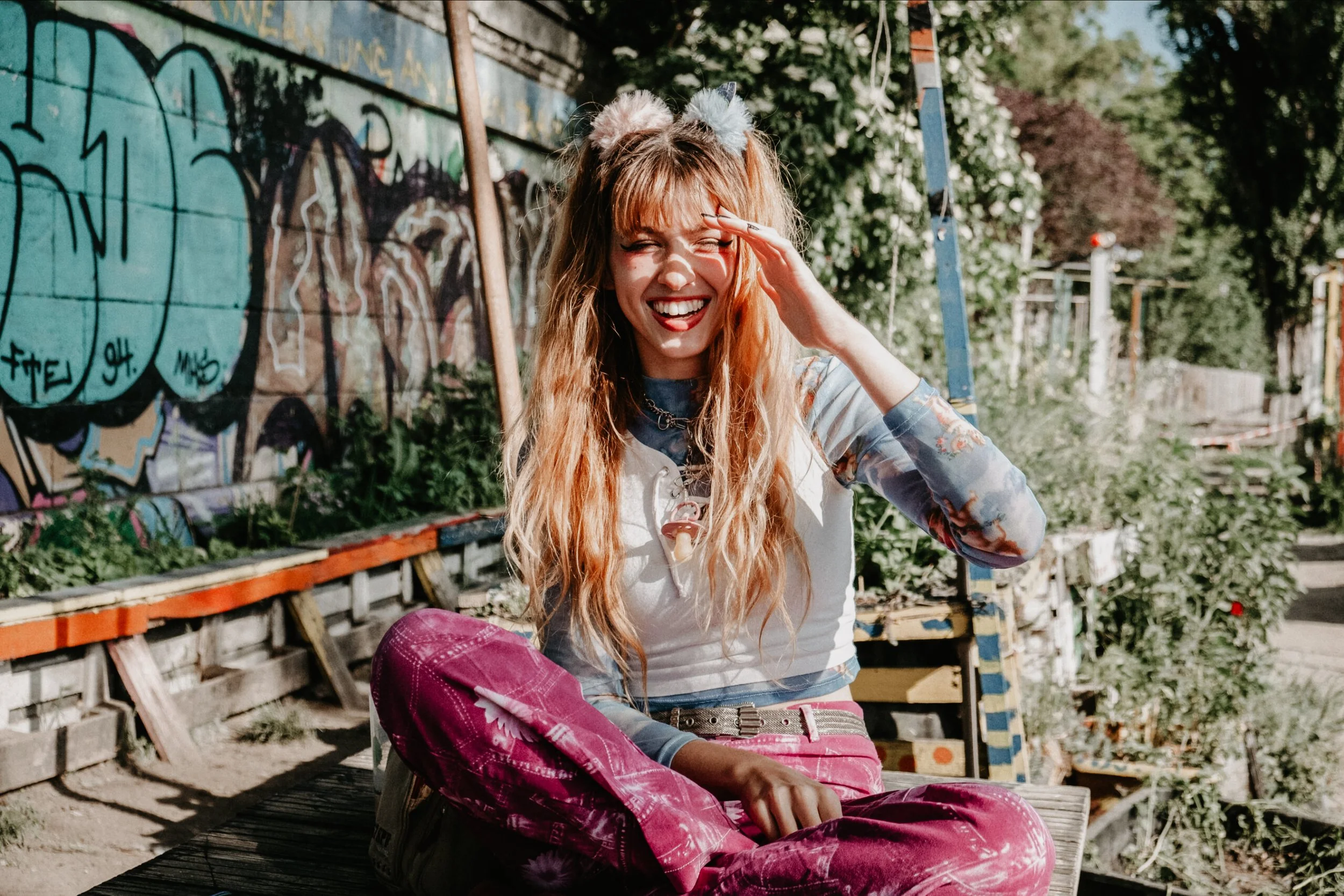
Savi Kaboo’s music is a sensory playground—twinkling pop production layered over soulful vocals with steady drumlines running beneath it all, creating a rhythm so fluid and addictive you can’t help but dance along. Her lyrics plumb the depths to which desire drags us and the heights to which it makes us soar. We spoke with Savi about finding freedom through art, the restorative power of nature, and why we should all wear face glitter more often. Please join us in welcoming her to the Half Mystic blog!
H/M: In the six years since your debut EP Elevate (2020), you’ve built an extensive discography that includes five albums, six EPs, and over 50 singles of smooth R&B–electropop fusion. How do you keep your well of creativity full and prevent yourself from burning out?
SK: Sometimes I wonder about that myself. I think it comes down to passion—I genuinely love what I do. Making music gives me purpose and meaning. Even the overwhelm of life is an inspiration to me. It’s an ocean of waves we can’t fully understand or control, and I’ve learned to stop trying to map it all out. I don’t try to fight it—I just float and swim, trusting that I’ll be carried where I need to go.
You draw influence from house music, confessional songwriting, and your Egyptian roots to create an impressively distinctive sound. If you were to name a new subgenre for your music, what would you call it?
Confessional songwriting greatly inspires me. My music is very me, so if I had to name the genre, I’d probably just call it “Savi Kaboo.” It feels strange to put my work into a box when it arrives from such an intuitive place. It’s honest and fluid, and it doesn’t really want to be defined by other words.
Your lyrics are suffused with vivid references to the natural world: The sun never goes down where you are / and so I always find you never far / in the night sky you’re like a shooting star (“Love you”); Maybe I should stop comparing you to forests that may be beautiful but keep growing without me (“Aligned”). How does your connection with nature inform your songwriting process?
When we move away from nature, our true origin, things start to feel strange and disorienting. I can always tell when I need grounding; I feel a deep urge to submerge myself in nature, my body asking for something essential. Living in the city can feel very unnatural sometimes. Real nature is like a bath for my soul, resetting me in a way nothing else can. I need to feel the trees, the wind, the dirt—physically, not just conceptually. To me, it’s obvious that this is healing. Humans are natural beings, but paradoxically, even cities full of them can feel dull and detached, without plants to connect us and foster conversation.
Nature inspires me deeply because my music comes from my understanding of myself, and nature strengthens that understanding. It brings me back into the present moment and reminds me of what matters. Many of my songs are inspired by humanity’s relationship to nature—how we move toward and away from it, and what we lose or find in that process.
Part of why I connect with your music is the clarity with which you articulate the experience of deeply desiring an emotional connection with an avoidant person, but also moving through that anguish to a sense of acceptance. Your recent single “In the Wind” is a poignant, mature reflection on a past relationship in which the speaker comes to a realization that allows her to release her heartbreak: Maybe I never wanted you at all / just wanted you to let me in. After losing yourself in love, how does songwriting help you find your way back home?
Songwriting reflects my current state back to me more honestly than almost anything else. It feels like a way to access my subconscious, like something in me is speaking before I fully understand it.
And sometimes that’s hard! Writing has made me spiral when it forced me to confront truths I wasn’t ready to understand yet. But part of the process is really examining the feelings without turning away. That kind of clarity can be uncomfortable, but it’s also what helps me move forward. It shows me what I want to change and where I want to go. Sometimes you know the truth intellectually, but it takes longer to emotionally catch up. Songwriting bridges that gap for me—it helps me feel my way into understanding, and eventually back into myself.
In addition to your music career, you are a multimedia artist whose repertoire includes sculpture, poetry, and painting. Do you find similar themes of desire and heartbreak manifesting in other media, or do you gravitate toward different topics through these art forms?
The themes are very similar—heartbreak and loss, freedom, nature, the people I love. I absorb everything through a sensitive, receptive lens, and it bursts out of me in whatever medium feels right at that moment. It’s less of a conscious choice and more of an instinct. Some feelings want to be songs, others want to be visual, still others want to take up space in physical media. I consume the world very intensely, and it comes out of me in many overlapping forms. All of my art arises from the same place, but expressed in different languages.
You write, record, and often produce your own songs, and have been releasing them independently of a record label since the beginning of your career. How has the freedom to control every stage of the songmaking process shaped your craft as an artist?
I serve as my own label, which feels very much aligned with who I am and how I want to move through the world. Freedom is one of my favorite feelings, and a huge theme in my music. Maintaining full control lets me play without asking for permission or allowing outside opinions to shape the process too early. It pushes me to follow ideas all the way through, even if they’re strange or unexpected. That’s where the most interesting experiments usually happen. I think that kind of freedom keeps the work honest.
Music production is an incredibly male-dominated industry. What advice would you give to young women who are interested in exploring the creative possibilities of the field?
It really is, and I wish more young women would dip their toes in. Music production opens up so many possibilities. It’s not even my favorite part of the process, but when I hear amazing production work, I’m always thinking, damn, I want to do that. There’s something really liberatory and powerful about shaping the entire sound of a track.
As for advice—I’m very playful with production and love to break the rules, so half the time I don’t even know how I made something in hindsight. When I listen back, I’m asking myself, how did I do that? It really is so experimental. But I think that’s the beauty of it! So if it’s something you’re passionate about, give yourself space to be messy and curious, not just chase perfection. Production becomes incredibly fun as you grow into it and your unique style starts to emerge.
To me, your sound is reminiscent of artists like Empress Of and Mahalia, who blend soul-inspired vocals with contemporary production. Could you share some of your personal music heroes with us?
There are so many artists whose voices, lyrics, production, and presence feel incredible to me. It’s hard to narrow down the list, but a few I love are Dounia, Lil Peep, Little Simz, Mac Miller, and Jorja Smith. They all bring a really distinctive honesty to what they do. Mostly, I love diving into music that isn’t big or commercialized yet—that special moment of finding an artist organically, without expectations, and letting them grow on you. I’ll add songs from those smaller artists to my playlists and listen until I’ve memorized every word. They start to feel like little worlds I’ve lived in for a while.
Face glitter is a crucial part of your persona. You’ve stated that this is an intentional choice to spread joy (from your song “Glitter”: Look into my eyes, the glitter’s supposed to make you smile). Can you speak to the necessity of cultivating a sense of enduring joy and wonder?
I love glitter! It’s magical and fun—such a small thing that can shift your mood, or someone else’s, in an instant.
In general, I believe that we are all free. Who we truly are lives beyond the physical; our essences are uncontrollable and uncontainable. When we remember that, there’s really nothing to be afraid of. It doesn’t mean the world isn’t heavy sometimes, but that knowledge gives us a different way of moving through the weight of it all. So I try to take care of myself and others. To be compassionate. To stay true to who I am. That’s what really matters—holding onto the light.
Savi Kaboo is an independent artist, songwriter, and producer based in Vienna. Her sound moves between alternative pop and R&B, shaped by international roots and a genre-fluid approach to songwriting and production. Since 2020, Savi has been releasing music independently, beginning with her immersive debut Elevate, a five-track project that introduced her poetic, emotionally driven style. Her recent releases reflect an evolving sound that balances intimacy and energy, blending warmth, groove, and modern pop sensibilities. Explore more: Instagram | Patreon | Bandcamp | Youtube | Spotify