“What have we lost in the separation of me from you?” (Jordan Escobar on Vesper)
Jordan Escobar is a contributor to Half Mystic Journal Opus II, Issue III: Vesper. He is a writer from Bakersfield, CA and the author of the chapbook Men With the Throats of Birds (CutBank Books). He is a 2023 winner of the St. Botolph Emerging Artist Award and a 2022 Djanikian Scholar in Poetry with The Adroit Journal. He has received scholarships from the Community of Writers and the Fine Arts Work Center. His poetry has recently been published in Ploughshares, Copper Nickel, and Prairie Schooner. He currently teaches at UC San Diego.
We asked three Opus II, Issue III contributors for their personal definitions of vesper: how it’s formed, where it’s been, what it could be. Here is Jordan Escobar’s vision of an event horizon, a bell tolling in a vacuum, a cicada’s song harsh and generous enough to wear twilight to bone…
I was nineteen, the youngest there. I had spent the day riding the bucket of a frontloader, stopping at short intervals and laying irrigation piping across acres of garlic. The Central Valley sunlight swarmed across my body. Sweat drained in a languid migration down to my ankles. Soil was in my lungs. Hours careened into further hours, until finally, distantly, the horizon trickled red. We were approaching the close.
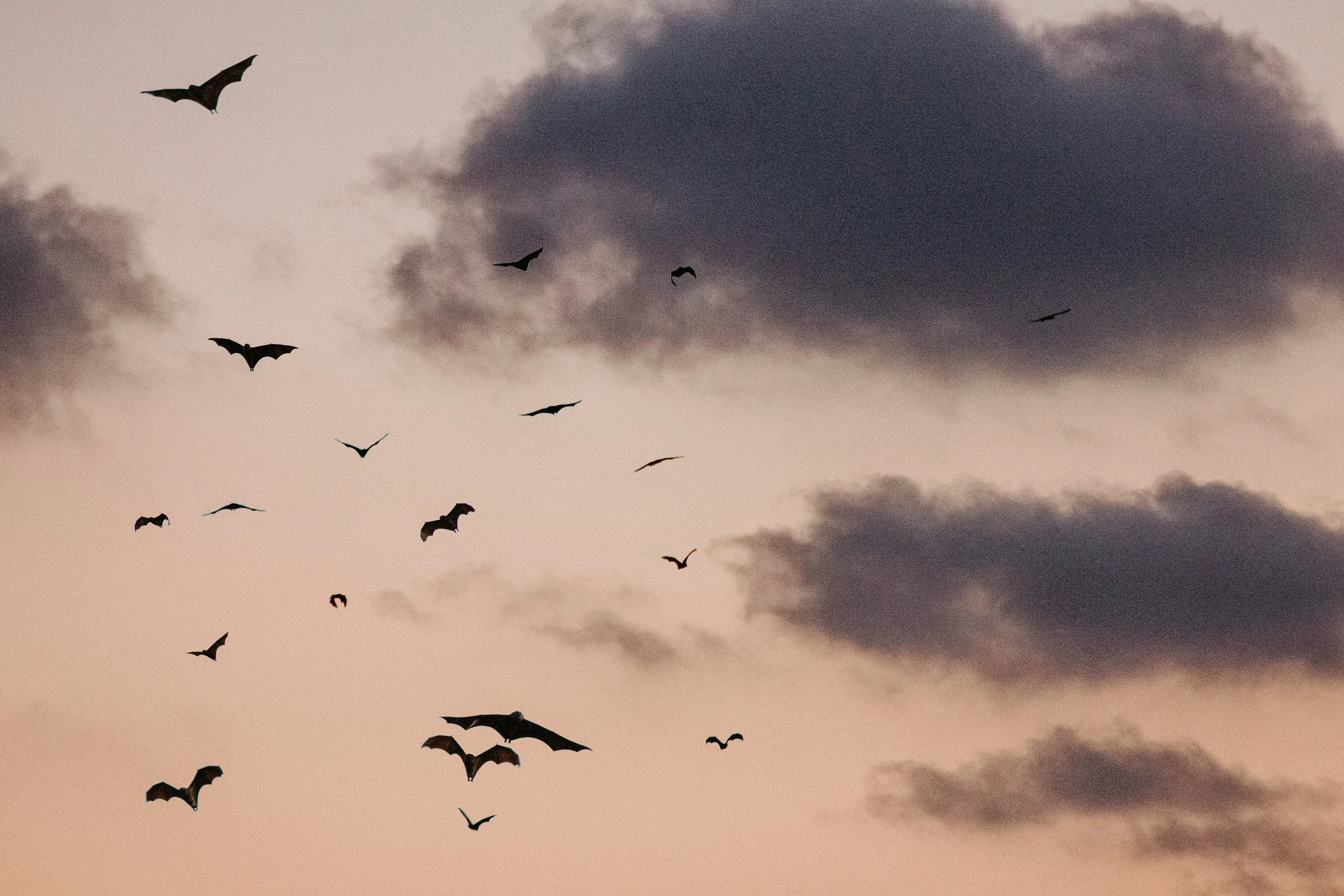
The sky bloomed into a sequence of deeper hues: persimmon into fuchsia. Hilario swung the tractor around, and we headed back to the shop, the parking lot, and our cars. An old vending machine still held cold Coke cans; some men were sipping, sitting on upturned buckets. Now the sky breathed like a puttering ember, flaming streaks of light outlining our faces. I found a spot on the back of a tailgate, pressed a Coke to my temple, and looked overhead. The dark curve of Earth reigned over me. In its dominion, shifting bodies darted. They flashed and clicked, swallowing barely visible insects. Then they dove with a fresh vigor. The bats were clocking in.
Bats have become an emblem for me of creatures that thrive in the penumbra, linger in the space between worlds. The crepuscular zone. I remember learning that word to describe the behavior of certain animals. Not nocturnal or diurnal, but crepuscular. The moment when something creeps into something else; the pause before a new reality blankets all you once knew.
If you ever attend a classical music concert, and you get to the venue early, you can see the moment when the musicians first take their instruments out of their cases. They all tune to each other, holding a shared note, waiting until they become something new: one mass, one body. Each voice thrums into a single sound. As that sound is held, it wanders through the concert hall. It fills the room with its largesse, the musicians letting themselves wait in a moment of becoming.
At the university, I see students in the gloam after class, their faces lit dimly by screens. They rush from place to place, so concerned with an ill-defined sense of efficiency. Rarely are they given a moment to hesitate, to look around and see what they’re becoming—cogs in a machine they cannot operate.
And yet there is an insistence that they must become more of what they are, an inadequacy manifest through constant digital comparison. Every aspect of their being is reduced to a calculable metric: pounds, calories, grams of protein. So much so that they are denuded of the pleasures of life, the textures and tastes of complexity. Food is reduced to selective nutrients, just as bodies are reduced to selective ideals.
In her poem “The Dogs at Live Oak Beach, Santa Cruz,” Alicia Ostriker wonders “if there could be a world / of absolute innocence / in which we forget ourselves,” one in which we are “pursuing pleasure / more than obedience.” This is the world of crepuscular animals, the place where big-eared bats chase silk moths, where evening becomes a stage raised for a drama of bodily whims, enacted over and over again.
Essayist John Berger comments that “The eyes of an animal when they consider a man are attentive and wary. The same animal may well look at other species the same way. He does not reserve a special look for man.” We are just part of the scenery, of the same collective moment, a constancy inhaled in a single gulp. What have we lost in the recognition of our otherness, in the separation of me from you?
When I listen to the spill of Debussy’s “Arabesque No. 1,” I hear how the notes swim into a river, how they cascade. The fact that you are flowing matters more than where you’re flowing to. You can be gentle with yourself in those moments where nothing is measured, when bats first descend from their roosts. Those moments that allow you to look into the sky and see day change over to night, and know too that this is nothing, this is always, this is eternal, that every day becomes every night and every night succumbs to every day. We don’t have to bruise ourselves to be in love with this process. We can listen to the music and let the evening carry us.
The poet James Wright once wrote, “Suddenly I realize / that if I stepped out of my body / I would break into blossom.” Let us step out of our bodies. Let us pause in the transformation, before we break into blossom.
Jordan Escobar’s “Protein Powder in the Evening Light” is featured alongside twenty other pieces in Half Mystic Journal Opus II, Issue III: Vesper, a constellation of contemporary art, lyrics, poetry, and prose dedicated to the celebration of music in all its forms. The vesper issue does not arrive so much as descend: unhurried as smog or sleep paralysis, inevitable as the ouroboros’ endless coil. A shattered mirror multiplies the face of darkness, silence textured and breathing, the body made uncertain of its edges. You’ve been here before, in the dream that returns you always to the same locked room. The door opens only inward. You’ve been knocking all night. Come inside.